




All about fast charging
What is fast charging? How does it work? How fast can it really get? Our charging expert Luc Bronk answers these questions below.
The basics
What is fast charging? And how is it different from ‘regular’ charging? All batteries — including those in electric vehicles — use Direct Current (DC) for charging and discharging. But the electric grid delivers Alternating Current (AC). Therefore AC from the grid needs to be converted to DC, so it can be used to charge the battery. This is done by an AC/DC converter.
This AC/DC converter is part of what we call a charger. Chargers can either be integrated into the vehicle as an onboard charger, or chargers can be external to the vehicle (for example, the fast chargers you find at Fastned stations). Today, virtually all electric vehicles have a small onboard charger. You can use a cable to connect the onboard charger to a regular AC socket in your garage or plug it into a charge point. The charge point delivers the AC required for the onboard charger to charge your battery.
AC vs DC
The main difference between Direct Current and Alternating Current is that DC delivers a constant voltage. Think of a stable, straight line, where the electrons flow in one direction. As the name implies, Alternating Current fluctuates. The voltage periodically changes from positive to negative and back again, creating a wavy line.
If you want to charge faster, the AC/DC converter and hence the charger need to be bigger. But a bigger charger is heavier, takes up more space in the car and adds complexity and cost to the vehicle. On top of that, every component in a vehicle needs to be automotive grade to ensure its reliable operation for the lifetime of the vehicle. So vehicle manufacturers usually choose a relatively small — and therefore slow — onboard charger to optimise between these factors.
Fast charging is different
An external charger that does the AC/DC conversion can be a lot bigger, heavier, more complex and more expensive than an onboard charger. But it is also a lot faster. That is why they are usually referred to as ‘DC fast chargers’ or just ‘fast chargers’. A typical fast charger delivers 300 kW which charges a vehicle about 25 to 80 times faster than an onboard charger. The next generation of fast chargers were introduced in early 2023 and deliver 400 kW. More on the impact of this later.
How fast charging works
A vehicle battery consists of many ‘cells’. A single cell is quite similar to a rechargeable battery you use at home, only bigger. A Lucid Air with an 112 kWh battery pack contains 6,600 individual cells. A BMW i3 with a 21.6 kWh battery has just 96 cells, but its cells are larger than the cells used by Lucid. Together with all wiring and packaging the cells form the battery pack as depicted below.
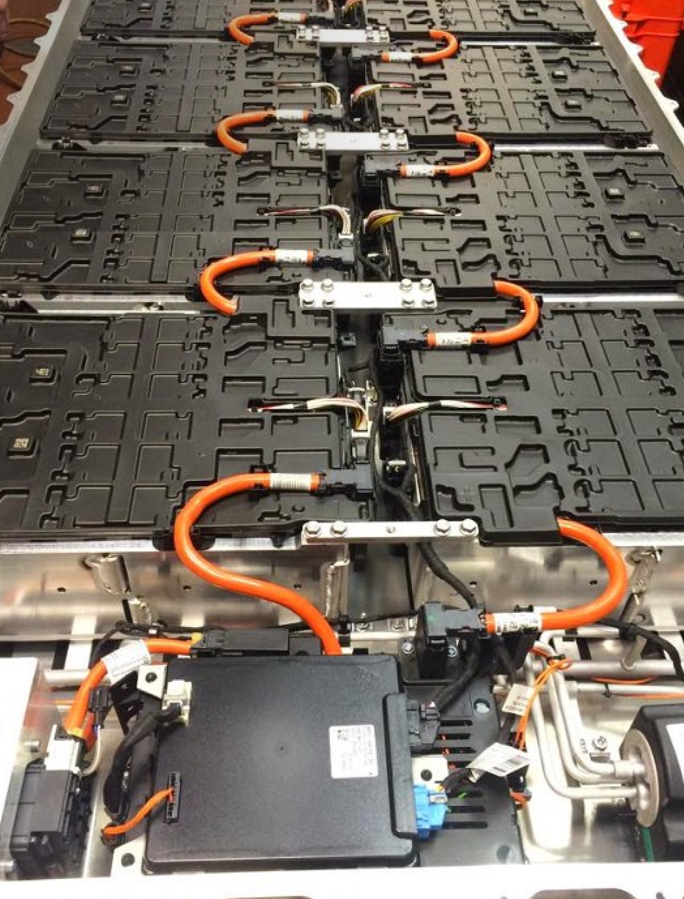
“Today’s battery packs are designed with fast charging capability”