


WHAT IS DC FAST CHARGING?
If you’re considering an EV, charging speed is crucial. DC fast charging, the quickest method, is essential for public infrastructure, long trips, and short stops when drivers need a quick battery top-up.
WHAT IS DC FAST CHARGING?
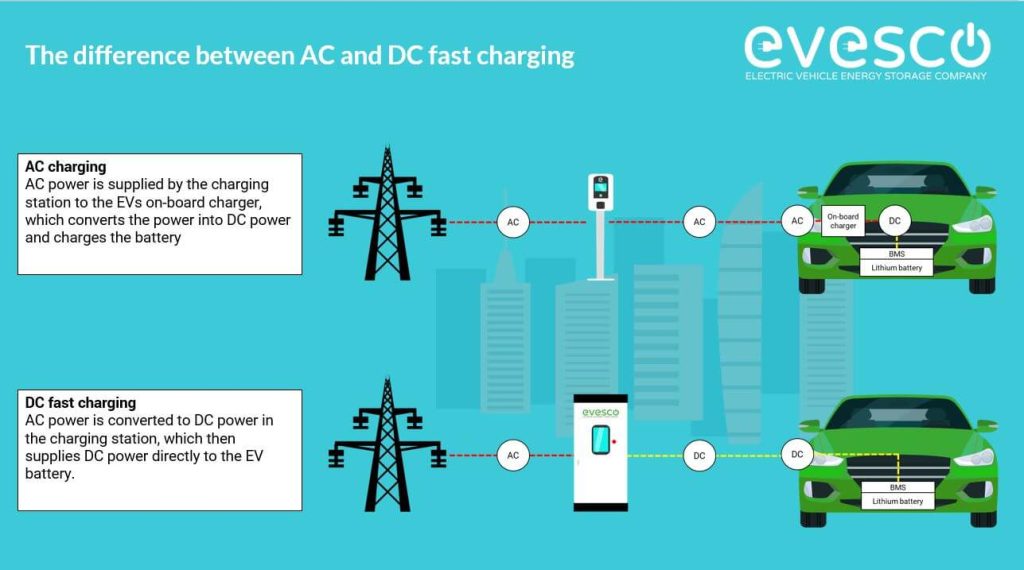
EV batteries store DC power, while the grid provides AC. On-board chargers convert AC to DC, but DC fast charging bypasses this, converting power at the station and charging the battery much faster. Known as DCFC, Level 3, or rapid/ultra-fast charging, it significantly reduces EV charging time.
WHAT ARE THE DIFFERENT LEVELS OF EV CHARGING?
Level 1 EV Charging
Level 1 is the slowest EV charging, using a standard 120V AC outlet with 1–1.8 kW output, adding 3–7 miles of range per hour. It’s impractical for regular use and unavailable in regions with higher household voltages, like Europe.
Level 2 EV Charging
Level 2 charging is faster than Level 1, using 208–240V in North America or 230–400V in Europe, with 3–22 kW output, adding 10–75 miles of range per hour. Level 2 stations are common at homes, workplaces, and public locations.
Both Level 1 and Level 2 EV chargers deliver AC power to the electric vehicle.
Level 3 EV Charging – DC Fast Charging
Level 3 DC fast charging is the fastest EV charging, delivering 15–350+ kW directly to the battery via three-phase connections, charging a standard EV in 15–60 minutes—much faster than Level 1 or 2 chargers.
WHAT IS THE DIFFERENCE BETWEEN AC AND DC FAST CHARGING?
EVs charge via AC (Level 1 or 2) or DC (Level 3 fast charging). While the grid supplies AC, batteries store DC. AC charging converts power on-board, which is slower, whereas DC fast charging converts it at the station, bypassing the on-board charger and delivering more power, making Level 3 charging much faster.
POWER VS VOLTAGE AND CURRENT
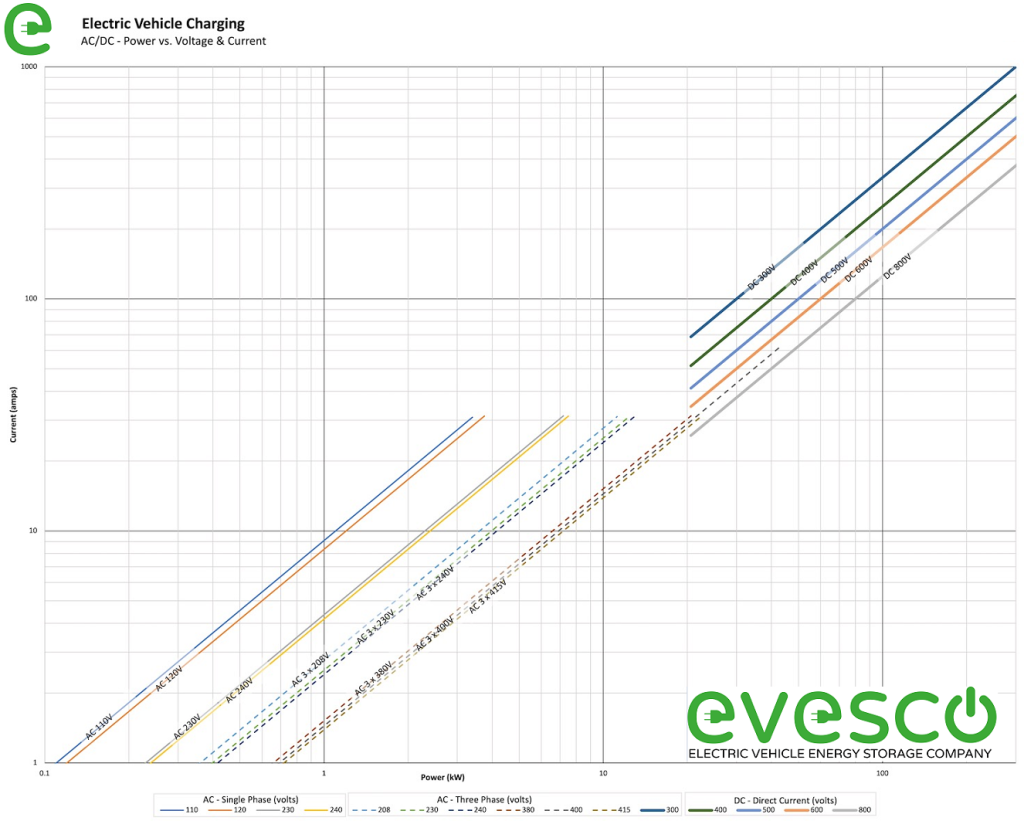
At a constant power (kW), DC charge current depends on the vehicle’s battery, charge voltage, and state of charge (CC-to-CV profile).
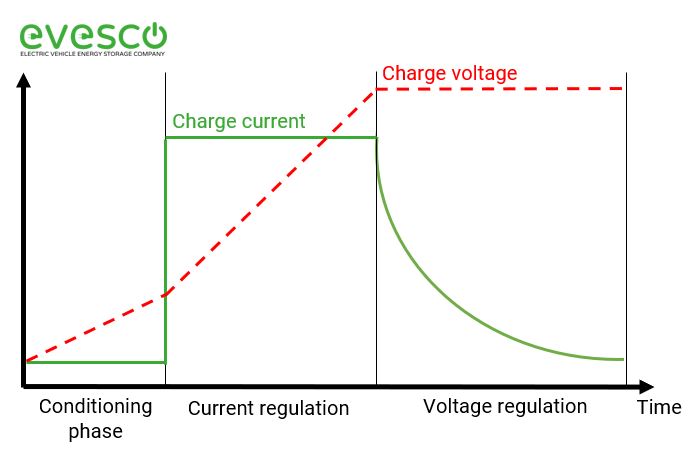
DC fast chargers deliver constant power with voltages typically between 200–1000 V. The EV’s BMS ensures charging stays within battery limits and communicates demand to the charger.
HOW DOES DC FAST CHARGING WORK?
During DC fast charging, the EV constantly controls its power draw. Charging speed mainly depends on the station’s output, the vehicle’s acceptance rate, and the DC charging curve.
Rate of Charge of a DC Charging Station
EV charging stations are rated by maximum output power (kW), called the charging rate. DC fast chargers range from 15 kW to 350 kW, with megawatt stations under development at 1000 kW. Higher kW generally charges faster, but an EV’s acceptance rate ultimately limits the charging speed.
EV Charge Acceptance Rate
An EV charge acceptance rate is the maximum amount of power in kW that an electric vehicle can input. The EV’s battery management system communicates its charge limits to the DC fast charger. Early EVs had low acceptance rates, but newer models support higher rates for faster charging.
For example, a car with a 50 kW charge acceptance rate will charge at roughly 50 kW regardless of whether the DC fast charger is 50 kW, 100 kW, or 350 kW. Conversely, the Porsche Taycan, for example, can accept up to 270 kW, but charging at a 150 kW station limits it to 150 kW.
DC Fast Charging Curve
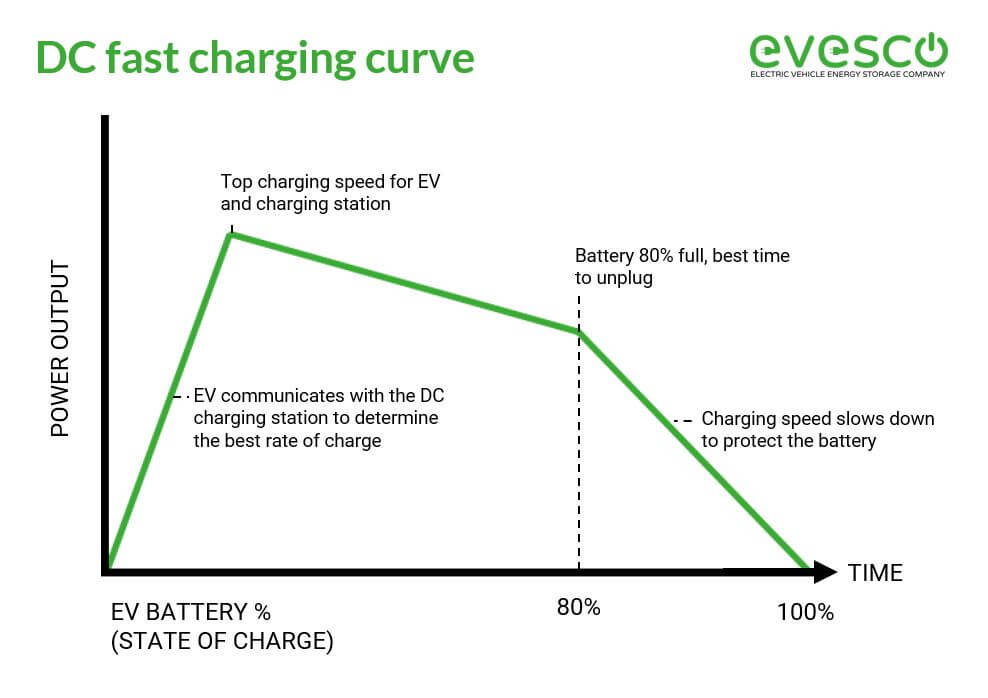
The DC fast charging curve also affects EV charging time. Each EV has a unique curve showing how much power it can draw as the battery charges. Typically, an EV charges at its maximum rate only partway through the cycle, then slows as the battery fills—often dropping sharply after 80% SOC. Charging to 80% is generally recommended to extend battery life and free the station for other drivers.
WHAT TYPES OF DC FAST CHARGING ARE THERE?
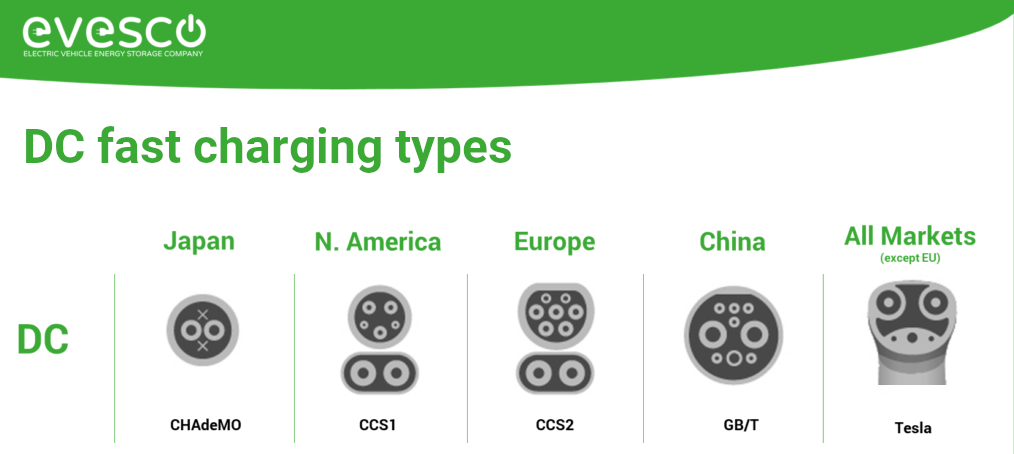
There are four main DC fast charging connectors worldwide: CCS, CHAdeMO, GB/T, and Tesla Superchargers. Connector compatibility depends on the EV make and model. CCS has two types: CCS1 (North America) and CCS2 (Europe). CHAdeMO is mainly for Japanese brands but is being replaced by CCS in new models. GB/T is used in China, and Tesla Superchargers serve all Tesla vehicles except in the EU.
HOW FAST IS DC FAST CHARGING?
With varying EV battery capacities, DC fast charger power outputs, and other factors affecting speed, exact charging times are hard to pinpoint. However, we can estimate how many miles of range a DC fast charger adds in 60 minutes based on charger power and the average EV efficiency of 34.6 kWh/100 mi.
| 30 kW | 87 miles/hour |
| 50 kW | 145 miles/hour |
| 100 kW | 289 miles/hour |
| 120 kW | 347 miles/hour |
| 150 kW | 434 miles/hour |
| 180 kW | 520 miles/hour |
| 250 kW | 723 miles/hour |
| 350 kW | 1012 miles/hour |
HOW MANY KW IS A DC FAST CHARGER?
The higher the output power (kW) of a DC fast charger, the quicker it can potentially charge an electric vehicle. The kW output power can vary depending on the installation location, the brand, and the model. Current DC fast chargers on the market range from 15 kW to 350 kW. DC chargers can be standalone, delivering full power to one EV, or split, sharing power across multiple vehicles simultaneously. At EVESCO, we have both standalone and split DC fast chargers that span from 50 kW upwards.
CAN ALL EVS USE DC FAST CHARGERS?
Battery electric vehicles (BEVs) typically support DC fast charging, with charge acceptance rates varying by model—some up to 300 kW, like the Lucid Air Dream Edition at 297 kW. Early BEVs and hybrid EVs (HEVs) often cannot use DC fast charging due to small battery capacity. When choosing an EV, consider both battery capacity and charge acceptance rate to maximize DC fast charging use.
IS DC FAST CHARGING BAD FOR AN EV BATTERY?
The simple and quick answer is not really. The accepted notion within the industry is that the faster the charging, the faster the EV battery capacity will decline, which is technically accurate. However, the Idaho National Laboratory study looked into how fast charging affects battery life. It showed that even if the only type of charging used was DC fast charging, the difference in the rate of decline of the EV battery capacity compared to Level 2 AC charging is minimal.
Every electric vehicle battery has an advanced Battery Management System (BMS), which has set parameters specifically configured to prevent damage to the EV battery. The BMS controls the charge acceptance rate and monitors the battery temperature, and if needed, can lower the rate of charge to protect the battery.
While DC fast charging can affect an EVs battery life, it is minimal and doesn’t damage the battery.